Flower Pictures

Origami


Who's Online

We have 20 guests online

Flower Poems

In Love with the Wind
      
The wind blows on
to every horizon
passing through the earth
where it could be heard

Here comes a flower
in its flourishing
the spirit of the wind
soaking in every inch of its living

Shaking and trembling
the flower nearly stops breathing
Screaming and shouting
the flower rebels from its rooting

Struggling against its origin
the flower dreams to fly away
to be free,
gone with the wind

But the wind is gone,
leaving the flower alone,
scattered like a fragile bone
until its days are gone

Anggie Servian


Partners


Flowers Arena - Sites for flowers

Clipart

Clip-art


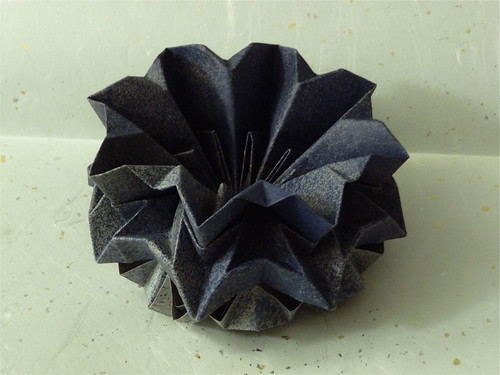
Nonagon Radial, by Andrew Hudson
PDF Print E-mail
Wednesday, 03 June 2009

Week 23, and I've been working on a big project-- designing and diagramming this model. While I did the last couple pages of diagramming a little hastily to get it out on time, I still think this is one of my best posts to date, and i hope you enjoy folding it as much as I did!

Some advice-- fold especially accurately for this piece. It's got some strange symmetry, so make sure what you're doing checks out with what the diagram says to.

Diagrams here.


Read More
 
Yellow Ribbon, by Andrew Hudson
PDF Print E-mail
Tuesday, 26 May 2009


On the last Monday in May we in the U.S.A. celebrate Memorial Day. On this day we pay our respects to the brave men and women who have lost their lives serving this country. In honor of the occasion we at Origami Weekly present a yellow ribbon. The yellow ribbon serves as a small token of our support for our troops, and our wishes for them to return home safely. God bless our troops and God bless America.

Diagrams here: Yellow Ribbon

Fold a ribbon and show your support!

See you next time!

--Jared

For our viewers from other countries: the yellow ribbon does represent a similar sentiment in many nations. Also, if made from a different color, the same style ribbon has come to represent awareness of many other things, such as pink for breast cancer, or red for AIDS. Feel free to fold a ribbon for your cause, whatever it may be.


Read More
 
About Flowers
PDF Print E-mail
Wednesday, 20 May 2009

What is a flower? So simple a question would scarcely need an answer if flowers were only just as simple. Actually they are extremely complex and it would cater to the vanity of the sentimentalist if we could say they where created only for our enjoyment -- their alluring forms, their color and frequently their quite seductive odor. But such a concept is fantastically false. The true function of flowers is reproduction and nothing else, and upon the sex life of flowers our very existance depends. Without it there would be no weat or rice, no coffee or chocolate, no timber or cotton, no quinine or digitalis, and in a few years the earth would return to something like its reputed condition in the first chapters of Genesis.

In what does the sex life of flowers consist? Basically it is very like the reproduction process in man or any other animal. Male and female must be brought together at the proper time in order that fertilization may be completed to perpetuate the race.

How do flowers accomplish this? While the sex organs of flowers are their most essential organs, they do not usually stand naked and their arrangement within the flower is neither an accidental nor has nature left these delicate sex organs without proper protection. To understand their arrangement it is necessary to look at a typical flower rather carefully. Just the beneath the showy petals is a usually greenish envelope known as a calyx which is often divided into individual sepals. This calyx usually covers the flower while it is stil in bud, and even after the flowers opens is still the outer envelope of normal flowers. The next inner circle of organs comprise the petals, which are sometimes of seperate segments, as in a pink, but are quite often united to form a cup-shaped corolla, as in the lily-of-the-valley.


Flower Reproduction


Within these outer envelopes of calyx and coralla are placed the sex organs. They consist, usualy of a central female organ, including an ovary, clustered around which are the male organs of stamens. These produce the familiar yellow "dust" which is the male fertilizing pollen. This, at the proper time, must be deposited upon the prolongation of the ovary (known as the style and stigma). This usually happens when the stigma is slightly sticky. What is called pollination is then completed, and the stage is set for the fertilization of the ovules. It is these fertilizied ovules (future seeds) within the ovary (the future fruit) that ensure the perpetuation of nearly all flowers.


1001 Questions Answered about Flowers By Norman Taylor
Last Updated ( Wednesday, 20 May 2009 15:59 )
 

Page 7 of 14


Copyright © 2009 aboutflowershome.com. All Rights Reserved |Privacy Policy.